Saturday, 24 August 2013

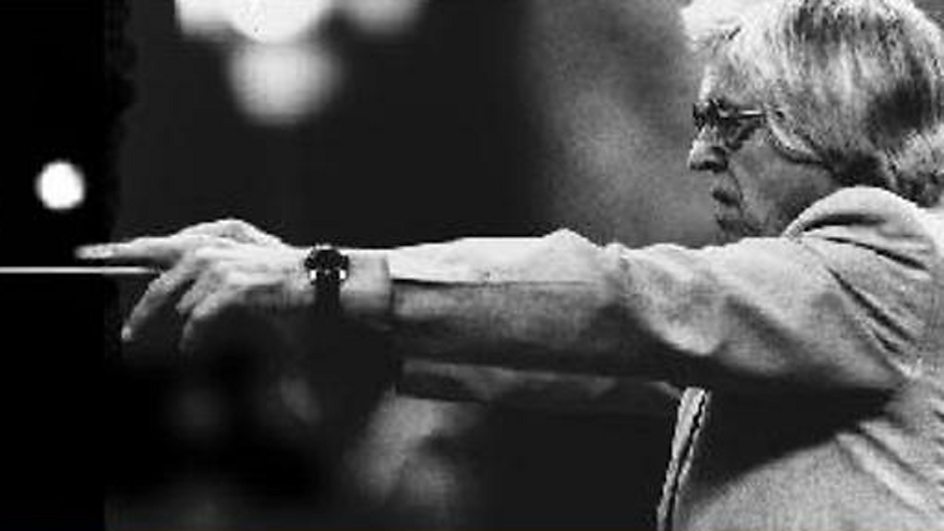
Program No. 69 - George Lloyd

George Lloyd would not be considered one of the most prolific composer of music for brass bands, nor did he solely concentrate on brass band music. His brass works, though, are considered part of the standard repertoire of brass band contesting works, and have been since his first brass band composition in the mid 1980's.

Born in Cornwall in 1913, Lloyd was brought up in a very musical family with his father an accomplished flautist and his mother able to play violin, viola and piano.  He started composing music when he as 9 years old, with serious study of composition when he was 14.

Over his musical career he penned no less than 12 symphonies, 7 concertos, and a variety of other works for voice, piano, orchestra, and of course brass bands.

Lloyd wasn't just a composer, though. During the second World War Lloyd joined the Royal Marines, as a cornet player in their band. During one voyage in 1942, as a result of tragic accident, the ship he was on (the HMS Trinidad) torpedoed itself, and many lives were lost in that incident. Lloyd himself was hospitalised for a number of years with what would now be called Post Traumatic Stress Disorder. He eventually recovered and was discharged in 1946.

Until 1972 he owned and operated a market garden where he grew mushrooms and carnations. During this time he continued composing, mostly before work started. After he sold his business he spent his remainder years composing a large number of his works, including all his brass band pieces. He passed away in 1998, aged 85.

1. H.M.S. Trinidad March (John Foster Black Dyke Mills Band)
We begin tonight with a march composed by Lloyd in 1941 for the ship he sailed on, H.M.S. Trinidad. This, together with a number of other works on the show, comes from a 1991 album released by the John Foster Black Dyke Mills Band, with David King as conductor, called Lloyd: English Heritage.

2. Symphony No. 10 'November Journeys' (Cory Band)
'When the BBC told me they would like me to write a piece for the Northern Brass Ensemble it so happened that about that time I was taking advantage of some cheap rail fares to visit various cathedrals I had never seen before. As I journeyed around the country I kept on thinking of sounds for the brass and these sounds became mixed up with the magnificent buildings I was seeing ; this led me eventually to write on the score ‘Impressions and reflections whilst travelling to visit some cathedrals’. There is nothing very ecclesiastic about the music except for the second movement, which is rather like a carol. I was able to have any combination of instruments I chose, so in order to achieve flexibility together with soft and bright sounds, I scored the work for 1 Piccolo Trumpet, 3 B Flat Trumpets, 1 Flugelhorn, 3 Horns, 3 Trombones, 1 Euphonium, 1 Tuba.’           George Lloyd (30 March 1981) 
This work was subsequently transcribed for Brass Band by Luc Vertommen. It is being performed here by Cory Band, with Dr. Robert Childs as conductor, from their 2008 album, Actaeon.

3. Royal Parks (John Foster Black Dyke Mills Band)
This was the first of the main works written for brass band by Lloyd (1984), actually written for the 1985 European Band Championships in Copenhagen. This piece is in 3 movements. The following description is from a distinguished brass band conductor here in Melbourne.
  •  Dawn Flights - military bandsmen are heading to a band performance in Regents Park. The "dawn flights" are the actual flights to this gig.
  • In Memoriam - The IRA bombed the bandstand on 20th July 1982, killing seven soldiers and injuring 24 others during a concert by the band of the Royal Green Jackets. The bandstand is sometimes called the "Memorial Bandstand" in memory of the dead soldiers. Lloyd actually lived nearby and heard the explosion.
  • Holidays - After this horrific event, the rest of the band are told to take some time off. This movement depicts the members attempting to take a holiday, but with the events of that day never far from their mind.
This performance is again from the album Lloyd: English Heritage.

4. Diversions on a Bass Theme (Oslofjord Brass)
The story goes that apparently complaints were made to Lloyd because Royal Parks was considered to be too easy for brass bands contests at the highest level. Lloyd thought to himself "I'll show them" and 2 years later Diversions on a Bass Theme was finished. Whether or not this is true is not that important, however it is true that this piece is a huge contrast to Royal Parks. The Bass Theme not only refers to the Bass end of the band, but also to the company that sponsored the work, Bass Brewery.

This performance is by Oslfjord Brass, from the 1997 Norwegian Brass Band Championships.

5. English Heritage (Black Dyke Band)

"The piece was commissioned by Michael Walker for the Historic Buildings and Monuments Commission for England – hence its title ‘English Heritage’ and was first performed jointly by Black Dyke and Grimethorpe Colliery, conducted by Geoffrey Brand at a Kenwood Lakeside Concert on 2nd July 1988 in the presence of the composer. Two years later it was chosen as the set work for the National Finals at the Royal Albert Hall, where the then CWS (Glasgow) Band conducted by John Hudson took the title." 4barsrest.com
This performance is by Black Dyke Band, from the 2010 Regional Contests.

6. Evening Song (John Foster Black Dyke Mills Band)
Interestingly, most reviews of Lloyd's brass band works seem to fail to mention this piece. But it is in a definitive list of works by Lloyd found here. It's also on the album Lloyd: English Heritage that we have already heard from. There isn't much else I can add, except for the fact that it was composed in 1991.

7. King's Messenger (Cory Band)
Cory Band were recently in Australia, and performed this piece in the concerts out here. This was Lloyd's final composition for brass band having composed it in 1993, aged 80. This piece is also why this program wasn't heard originally as intended a fortnight ago. The album that this is on, Words and Music, by Cory Band with Philip Harper as conductor, was only released just over a week ago.

I hope you enjoyed tonight's look at brass works by George Lloyd.

We've spent a fair bit of time over the last month or so listening to brass band music. We'll move away from that as next week's show will feature music performed by American trumpeter, Chris Botti.

Saturday, 10 August 2013

Program No. 68 - 2013 Victorian State Championships Music

At the end of last week's show I promoted this week's show as being all about the music of compose George Lloyd.

Whilst Lloyd was better known for his orchestral and choral works he did write 4 relatively well known major works for brass bands. I was hoping to play all four pieces for you on this week's show. Unfortunately in my research during the week I was unable to find a recording of King's Messenger. Then I found a recording that is being released next week. I have therefore decided to postpone by program of George Lloyd music until a later date.

Instead I will be representing a show I produced earlier this year looking at the music chosen as test pieces for the 2013 Victorian State Championships to be held in Ballarat next weekend (17th and 18th August).

You can find the full list of test pieces on the VBL website.

Please note I have not found recordings of all the test pieces for brass band on the show. In order to mix things up a bit I have included some non-brass band pieces. I'll explain more, later:

1. Nott'num Town (Allan Street)
This is one of the test pieces chosen for D Grade.

I have only managed to find one recording of this piece, and that is by a Concert Band. Here it is performed by The Band of the 9th & 12th Royal Lancers from their 2011 album, In Concert.

I have then found a brass band recording of one of the movements, Goose Fair. Here it is performed by Black Dyke Mills Band from their 1981 album Concert Sound, with Major Peter Parkes as conductor.

2. A Salford Sinfonietta (Darrol Barry)
I believe that this has been selected as a test pieces previously, for the B Grade section. This year it is one of the choices for C Grade.

Here it is being played by BNFL Band on their 1993 album Partita.

3. First Suite in Eb (Gustav Holst)
This is another selection for C grade, and here is another piece where I was unsuccessful in finding a recording of the brass band arrangement. Here it is, for concert, military band, with The Central Band of the Royal Air Force and Wing Commander Eric Banks as conductor, from their 2010 album British Music for Concert Music.

4. The Flying Dutchman: Overture (Richard Wagner)
The first of the selections for B Grade, and yet another piece where I couldn't find the brass band recording. Here is the original orchestral recording, performed by Royal Philharmonic Orchestra and Vernon Handley
as conductor, from the 2003 album Wagner: The Ride of the Valkyries, Overtures.

5. Royal Parks (George Lloyd)
The second of the selections for B Grade, this was one of 4 test pieces written by George Lloyd for brass bands. Apparently the story goes that people though this test pieces a bit too easy when it was presented by Lloyd. He made sure his next piece was much harder (more about that in our later show on George Lloyd).
This recording is from Black Dyke Mills Band with Major Peter Parkes as conductor from their 1986 album The Complete Champions.

6. Partita for Band - Postcards from Home (Philip Wilby)
This was also an option for B grade bands. Here it is performed by Grimethorpe Colliery Band from their 1993 album Wilby.

7. Rienzi: Overture (Richard Wagner)
This piece was provided as an option for A Grade Bands, but once again I couldn't find a recording of the brass band arrangement. Once again I have turned to an orchestral recording, from the same CD as before (See The Flying Dutchman, above).

8. The Legend of King Arthur (Peter Meechan)
The last recording chosen for tonight's show is also the newest. This piece was only composed in the last couple of years with this recording, from Foden's Band only released last year, on the album with the same name.

I'll be away at the State Championships next Sunday so there won't be a show next week.

The following week we'll have the results of the State Championships as part of our show featuring the music of George Lloyd.

Sunday, 4 August 2013

Program No. 67 - Music by Philip Sparke II

Program No. 62 was the first of our shows featuring the music of Philip Sparke.  This week we present our second program of his works.

1. Gala Fanfare - from Five Festive Fanfares (Williams Fairy Band)
We open the show with Gala Fanfare which was originally composed for a festival of bands that was a part of World Expo '88 in Brisbane. For those interested the other four fanfares are titled Champions Fanfare, Birthday Fanfare, Festival Fanfare and Victory Fanfare and were all composed for different events. Tonight's recording is by the Williams Fairy Band, with Phillip McCann as conductor, from the album Images of Brass (2001).

2. A London Overture (Britannia Building Society Band)
This is one of Sparke's earlier major works for Brass Band having been commissioned to compose a piece for the 1984 Dutch National Brass Band Championships and is one of the pieces heard consistently in brass band contests since. This particular performance is by the Britannia Building Society Band recorded at the 1991 European Band Championships.

3. The Vikings (Eikanger-Bjørsvik Musikklag)
First composed in 1989, this piece is performed by Eikanger-Bjørsvik Musikklag from their 1997 album, Philip Sparke.

4. Music for a Festival (Tokyo Kosei Wind Orchestra)
This piece was commissioned by the Boosey & Hawkes Band Festivals for the 1985 finals of the Youth Section in the National Brass Band Championships of  Great Britain. Sparke has written a lot of music for brass bands that he subsequently arranges concert bands, and vice versa. This, as you will note, is the concert band arrangement of the brass band work. It is performed here by the Tokyo Kosei Wind Orchestra with Philip Sparke as conductor, from the 1992 album Orient Express (European Wind Circle).

 5. Tuba Concerto - Allegro (Black Dyke Band)
This was commissioned in 2006 by German instrument manufacturer Miraphone. It is dedicated to, and first performed by, a long time friend of Sparke, Markus Theinart. The Concerto is in two movements (Lento and Allegro) but we will only be hearing the final movement, performed by Black Dyke Band with Nicholas Childs as conductor and Joe Cook as the soloist, from their 2008 album Music for Battle Creek - The Brass Band Music of Philip Sparke. We will be coming back to this CD for some of the rest of the music on the show.

6. Dances and Alleluias (Black Dyke Band)
This piece was commissioned by the British Federation of Brass Bands for their inaugural English National Brass Band Championships held in 2006.

Sparke describes the piece as follows:
My chief concern when writing Dances and Alleluias was that I knew I couldn’t continue the line of thought that had led to Music of the Spheres, a piece which had taken me about as far as I currently could (or wanted to) go in terms of scale and virtuosity. In addition, I wanted to write ‘absolute’ music rather than a programmatic piece but keep the same emotional journey which is for me the most important aspect of Spheres. 
My first idea for the new piece was a final ‘alleluia’ - I didn’t imagine any specific religious connection but wanted the slow music to be vocal in nature and ecstatic in mood, as that word implies. It was then logical to intersperse the slow music with faster dances. 
This piece is also one of the test pieces chosen for the A Grade section in this year's Victorian Brass Band Championships to be held in Ballarat later this month. My spies tell me that there is a chance that more than one of the bands has chosen this as their test piece.

Tonight's performance is again from the album Music for Battle Creek - The Brass Band Music of Philip Sparke, and again performed by Black Dyke Band.

This piece is in 4 movements and goes for about 14 and a half minutes. 

7. Pantomime (Britannia Building Society Band)
This solo work was commissioned by Nicholas Childs back in 1986. It is being performed by Britannia Building Society Band. Unfortunately my information does not indicate who the soloist is. This is again from the 1997 album titled Philip Sparke.

8. A Tale As Yet Untold (Eikanger-Bjørsvik Musikklag) 
I endeavoured to play this piece on the last Philip Sparke program, but technical issues foiled that attempt. Hopefully those technical issues have disappeared and we will be able to play this piece in full. For a description of this piece please read my program notes from that show.

9. Music for Battle Creek (Black Dyke Band)
This piece was commissioned by the Brass Band of Battle Creek, located in Michigan, USA. The music seeks to salute the American 'can-do' attitude, full of excitement, bravado and virtuosity.

This piece is in 3 movements:
  1.   Prelude and Toccata
  2.   Elegy
  3.   Rondo Finale
This is the title track of the CD we have used for a lot of this show, Music for Battle Creek - The Brass Band Music of Philip Sparke, and again is performed by Black Dyke Band.

That's it for this show. There's plenty more music from Philip Sparke that we haven't played yet, though we may leave it for a couple of months before we play the third program of this series.

For next week's show we'll be looking at another composer, Lloyd George, plus talk about the upcoming Victorian Brass Band Championships.


Saturday, 27 July 2013

Program No. 66 - Swing!

Choosing a music genre can be fraught with danger. Especially swing. I mean, what exactly is swing?

You can look at the Wikipedia definition that gives us:
the sense of propulsive rhythmic feel or groove created by the musical interaction between the performers, especially when the music creates a "visceral response" such as feet tapping or head nodding. The term "swing" is also used to refer to several other related jazz concepts including the sung note (a lilting rhythm of unequal notes) and the genre of swing, a jazz style which originated in the 1930s.
The music selected for tonight's program fits this general definition (hopefully).

1. Have You Met Miss Jones?
2. Beyond The Sea
   - Robbie Williams (Swing When You're Winning)
This album featured a bit of change in direction for Robbie Williams. Released in 2001, this was the "big band album he had always dreamed of making". This album was a commercial hit around the world.  Both tracks chosen were used in feature films. Have You Met Miss Jones? was recorded for the 2001 film Bridget Jones's Diaries and Beyond The Sea was used in the 2003 Pixar animation, Finding Nemo.

3. Sing, Sing, Sing
  - Cincinnati Pops Orchestra (The Very Best of Erich Kunzel • Cincinnati Pops Orchestra: Top 20)
Originally composed in 1936 by Louis Prima, this was most famously covered by Benny "King of Swing" Goodman. This version comes from the a  "best of" album, with Erich Kunzel conducting the Cincinnati Pops Orchestra, released in 1994.

4. Just The Way You Are
  - Rias Bigband (Pop Goes Swing)
I found this song on i-Tunes when I put together a Billy Joel in brass program last year. This is one of a number of songs on tonight that are a swing cover of a well known original song. This is performed by Horst Jankowski and Rias Bigband from their 1991 album Pop Goes Swing.

5. Three Kings' Swing - Swiss Army Brass Band (Best of Swiss Army Brass Band)
6. Swingtime Religion - Melbourne Staff Band (Celebration of Faithfulness)
7. A Song to Swing - David Daws (Golden Slippers)
Brass Bands have often been described as having the ability to swing "like a rusty gate". Having said that, these three pieces are worthy of inclusion in tonight's show. We start off with Three King's Swing, from the 2006 "best of" album by Swiss Army Brass Band.  We move on to two Salvation Army recordings. Swingtime Religion is from the 2007 Celebration of Faithfullness album by Melbourne Staff Band and then David Daws with the International Staff Band of the Salvation Army playing A Song to Swing from their Golden Slippers CD.

8. Don't Know Much About Love 
9. Lover Come Back To Me
  - Vince Jones and Grace Knight (Come In Spinner)
This music was for the ABC movie Come in Spinner, which was created back in 1990, and based on the book of the same name. It was set at the end of the Second World War.  The music was a collaboration of Australian Jazz masters, Vince Jones and Grace Knight.

10. American Patrol
11. Little Brown Jug
12. Hallelujah
13. In The Mood
Glenn Miller was a trombone player, and also one of the music giants in the early forties. His life was tragically cut short in a plane crash in December 1944, but in the 5 years before then was one of the best selling recording artists.  Miller was actually in charge of the Army Air Force Band as part of his services to the armed forces during the Second World War. This 50 piece band toured England in 1944, giving over 800 performances.

American Patrol and Little Brown Jug were recorded for the Academy Award winning movie, The Glenn Miller Story (1954).

Hallelujah was released on 2001 on Glen Miller. 25 Temas de lo Mejor del Swing Jazz.

One of his most famous works is In The Mood. I have chosen a recording from the TV show Scrubs soundtrack - Season 4.

14. Won't You Come Home Bill Bailey?
15. Do-Re-Mi
  - Harry Connick Jnr
The music of Harry Connick Jnr spans a number of genres, from funk to jazz to blues and everywhere in between. The Bill Bailey track is from his 2007 album Oh, My Nola. Do-Re-Mi is his arrangement of the famous track from the movie Sound of Music, and comes from his 2001 CD, Songs I Heard.

16. I've Got You Under My Skin 
17. Moondance
  - Michael Bublé
 A number of singers feature in tonight's show, all with fantastic backing bands. Bublé will soon be performing in Australia. I chose two contrasting swing tracks from his recordings. The first, I've Got You Under My Skin is a jazz classic from his 2011 album It's Time. Moondance, by contrast, is a song penned by Irish singer Van Morrison, which I found on Bublé's 2011 self titled album.

18. Candyman - Christina Aguilera (Back to Basics)
I feel the collective stares of everyone as they wonder why I have included this on tonight's program. Well, take a good listen to it. Sounds very much like an old Andrew Sisters song.  Aguilera has, successfully I believe, managed to translate the sound and feel of this well know group in a modern setting. Complete with brass backing.

19. Norwegian Wood
20. Big Swing Face
  - Buddy Rich
Rich was billed as "the world's greatest drummer" during his career, as he played with all the jazz greats, starting with Artie Shaw and Tommy Dorsey, all the way through to Louis Armstrong, Ray Brown and Ella Fitzgerald. It was in his final years in the late sixties when he led his own big band, in an era where the big band style was waning. These two tracks come from his 1967 album, Big Swing Face. The first track is a swing version of a Beatles song Norwegian Wood. The second track is from Bill Pottts and is the title track of the album Big Swing Face.

21. Waltzing Matilda
22. All of Me
  - James Morrison
As one of my favourite artists, it would have been difficult for me not to have included at least a couple of tracks from this Australian jazz legend.  The first track come from an album recorded live at the Sydney Opera House in 1996 and is a swing arrangement of Australia's unofficial national anthem, Waltzing Matilda.
The second track is from his latest CD released in 2012, Snappy Too and is his take on the classic song All of Me.

23. I Love Paris
24. Mrs Robinson
25. Mack The Knife
   - Frank Sinatra
I finish tonight's program with three recordings from a performer know alternatively as "Ol' Blue Eyes" or "Chairman of the Board", Frank Sinatra. In a career lasting 60 years (his final performance in 1995, when he was 80) Sinatra covered just about every popular genre over that period, having released 297 singles and 69 albums. It was difficult to only choose 3 songs from this huge discography, but in the end chose I Love Paris (which I have taken from the 2003 release of All The Best. Mrs. Robinson, another swing version of a popular song, is from his 1969 album, My Way. The final track (which I note is my most played track in my i-Tunes catalog) is Mack the Knife. Sinatra had released at last 5 different versions of this song, but this one, as a duet with Jimmy Buffett, is the best.

I hope you enjoy the program. Swing and brass go together so well.

Next week we return to the brass band scene and Part 2 of music by Philip Sparke.


Sunday, 21 July 2013

Program No. 65 - Øystein Baadsvik II

Back on the morning of 6th October last year my theme for the show was on legendary tuba player Øystein Baadsvik. I think it's about time we played his music again.

Baadsvik was born in Trondheim, Norway in 1966. He only started playing the tuba when he was 15 years old and only three years later won a national soloists competition. Since 1991 Baadsvik has played with orchestras all around the world as a soloist, including with the Melbourne Symphony Orchestra last year. He is considered by many to be the best tuba soloist in the world.

Baadsvik has released 10 CDs and we will be choosing the program today from a selection of those CDs:

We start the show with 4 tracks from his 2010 CD, Ferry Tales, which has Baadsvik being accompanied by Erland Skomsvoll on Piano and The Trondheim Soloists.

1. Déjà Vu (composed by Ø. Baadsvik)
This was titled thus because when the theme first popped in his head he was convinced that he had heard it before. After some thorough research he was satisfied that this is a new composition.

2. Sommernatt ved fjorden (Summer Night by the Fjord) (arr. E. Skomsvoll for tuba, piano and strings)
This seems to be a northern European classic song, but I love Baadsvik's explanation of the words to the song -
... when a young man goes out on the town, planning to pick up the girl he's in love with, and how those things gradually deteriorate until all that's left is to go home to Mummy for tea and sympathy.
3. The Wizard of Oz: Over the Rainbow (arr. E. Skomsvoll for tuba and strings)
This was originally composed by Harold Arlen and sung by Judy Garland in the 1939 movie The Wizard of Oz. That song won an Academy Award and was also voted as the best song of the century by the Recording Industry Association of America.

4.Vise (A Simple Melody) (composed by Ø. Baadsvik)
This was composed in 1997. The string arrangement was a project during composition classes with composer Bertil Palmar Johansen.

5. Tuba Concerto (composed by John Williams)
This is from the CD 20th Century Tuba Concertos, and is performed by Baadsvik with the Singapore Symphony Orchestra, released in 2008.

John Williams is best known for his movie music (think Star Wars, Jaws, Raiders of the Lost Ark, etc.) but Williams has also composed a number of orchestral works. Williams composed this concerto whilst he was a conductor with Boston Pops Orchestra, in response to a commission for the orchestra's centenary in 1985. It was dedicated to the orchestra's tuba player at the time, Chester Schmitz

The concerto is in three movements:
  1. Allegro moderato
  2. Andante
  3. Allegro molto

6. Ellens Gesang III (Ave Maria!), Op. 52, No. 6, D. 839, "Hymne an die Jungfrau" (arr. Ø. Baadsvik)
In 2011 Baadsvik released a Christmas CD called Snowflakes - A Classical Christmas, performing with Cantus (a women's choir) and the Trondheim Symphony Orchestra. There are some great renditions of traditional Christmas songs here, but as we are quite a few months out from that time of year, I have chosen Franz Schubert's Ave Maria, which can be found on many Christmas albums, although not composed for that purpose.

Tuba Carnival was released in 2003, and highlights the technical mastery that Baadsvik has of the tuba. A number of the pieces on this CD were not originally written for the tuba, but the arrangements for tuba would be a beastly challenge for most tuba players. Baadsvik is accompanied here by Musica Vitae.


7. Winter from The Four Seasons (arr. Ø. Baadsvik)
Antonio Vivaldi composed The Four Seasons in 1723, some 112 years before the invention of the tuba. This arrangement replaces the violin with the tuba, in one of the trickiest pieces I have heard yet for this instrument.  Winter is in three movements:
  1. Allegro Non Molto
  2. Largo
  3. Allegro
8. Carnival of Venice (arr. A. Baadsvik)
This piece, composed originally by Jean-Baptiste Arban as part of his 12 Fantasies with Theme, is part of the standard repertoire for brass soloists, though not often for tuba. This particular version has been arranged by Anna Baadsvik, Øystein's wife, who is an accomplished composer in her own right.

Chameleon was also released by Baadsvik in 2011 features a number of tuba works accompanied by the Fanfare Band of the Royal Netherlands Army 'Mounted Regiments'

9. Did You Do? (composed Ø. Baadsvik)
This is a word play on didgeridoo (or didjeridu), one of the oldest instruments in the world. Baadsvik bought one when he first toured Australia. This piece, as you will guess, is not played on the tuba, but on the aforementioned instrument.

10. Chameleon (composed M. Hamers)
Chameleon was the first work composed by Dutch composer Maurice Hamers and describes the ability of the chameleon to change colour depending on its surroundings and mood.

11. Memory of a Rose (composed A. Baadsvik)
Described in Anna's own words:
the piece was conceived after a very lifelike dream about the most unthinkable thing; the loss of that which one holds dearest to life. I was absorbed by the idea, and feeling deeply for all those who have actually experienced this, I set down my dream in music: an all-enveloping personal disaster which encompasses moods ranging from fury, the darkest sorrow and chaos to happy memories, heart-breaking loss and resignation.
I heard this work being performed by Baadsvik accompanied by Kew Band when he was in Melbourne last year, and was blown away by it. This is a profoundly moving piece.

12.Minuano (Six Eight) (arr. R. Farr)
This piece was originally from the album Still Life (Talking) by the Pat Methany Group. The title is taken from the name of the cold wind that blows in the south of Brazil and Uruguay. Ray Farr's arrangement is a popular piece to showcase the talents of the tuba player.

13. Fnugg Blue (composed Ø. Baadsvik)
If Baadsvik was best known for a specific work it would be for Fnugg, which went viral on YouTube a few years ago.

This extended adaptation of this piece is performed together with Christian Lindberg on trombone and the Swedish Wind Ensemble, from the album Baadsvik, Oystein: Prelude, Fnugg and Riffs, released in 2009. A great way to finish the show tonight.

Next week, after being set a challenge by one of our local identities up here in the Kinglake Ranges, the theme of the show will be "Swing!".
  

Sunday, 14 July 2013

Program No. 64 - Brass Bands Play Movie Themes (II)

Back on the 14th July last year (Saturday morning) I presented Brass Bands Play Movie Themes (I). Whilst we have had a lot of movie music over the last month or so, I thought it would be good to put on another program of brass bands playing movie themes.

Whether it is to fulfill Council or Shire obligations, as a fee for service, or for the publicity, just about every brass band would perform in public events during the year. A lot of the the time bands will play brass band arrangements of movie scores. I believe this is because a) the public like hearing it and b) most brass players actually like playing it. And with some of the best music composers around composing for films, like James Horner, John Williams, Howard Shore and Hans Zimmer there is plenty of music to work with, for brass band arrangers.

In the main, I have tried to avoid repeating tracks from my show last year, however there are a couple of exceptions. So, onto the program list:

1. Also Sprach Zarathustra - Black Dyke Band and others
Whilst this was not originally composed for the cinema (Richard Strauss composed it in 1896), most people, when hearing this music, would probably think it as movie music, and specifically used in the 1968 movie, 2001: A Space Odyssey. This recording is from a CD issued with highlights of the 2001 National Brass Band Championships and Gala Concert, and is performed jointly by Black Dyke Band, International Staff Band and Symphonic Brass of London.

2. Concert March from 1941
3. Circle of Life
4. For Your Eyes Only
5. The Mission
6. Eye of The Tiger
  - Brassband De Wâldsang
Brassband De Wâldsang is considered the premier brass band of the Netherlands, having won the National Championships a number of times. In 1995, under the baton of Rieks van der Velde, they released a CD titled Screen Blockbusters and these next 5 tracks are from that album.

We start of with music from John Williams and Spielberg's 1979 movie, 1941. This concert march is arranged by Steve Sykes.

We then move to the classic Disney animation, The Lion King (1994) and Circle of Life, with the music at the start of the movie originally composed by Elton John and arranged by Hans Zimmer. Unfortunately I am unable to work out which of the many brass band arrangements this is and therefore who the arranger is.

On next to a James Bond classic, with For Your Eyes Only (1981), and Bill Conti's theme song, arranged for brass band by Jan van Kraeydonck.

The music for the movie The Mission (1986) was voted in as the top movie music recently by ABC FM listeners. Originally composed by Ennio Morricone, this particular arrangement is by Frank Bernaerts.

The final track I have chosen from this CD is from the 1982 movie Rocky III, and the song Eye of the Tiger. This song was composed and performed the rock group Survivor, and was there greatest hit. It has been arranged for brass band by Rieks van der Velde.

7. Can You Read My Mind (Love Theme from Superman) - Eikanger-Bjørsvik Musikklag
Whilst John Williams is best known for his collaboration with director, Steven Spielberg, one of his most enduring scores is for a movie directed by Richard Donner - Superman (1979). The Love Theme from that score has been arranged for brass band by Ray Farr and is performed by Eikanger-Bjørsvik Musikklag (with Ray Farr as conductor) from their 1997 CD, Best by Farr.

8. Born On The Fourth of July - Yorkshire Building Society Band
Another John Williams score (most of them have been arranged for brass bands) and this time a movie directed by Oliver Stone - Born on the Fourth of July (1989). This recording is from the 2003 European Brass Band Championships Gala Concert and is performed by Yorkshire Building Society Band, with David King conducting.

9. Pirate Of The Caribbean - Brass Band Rekrutenschule Schweizer Militärmusik
Moving away from music by John Williams, the score for the orginal Pirates of the Caribbean movie (2003) was composed by Klaus Bedalt, with Hans Zimmer as producer. This arrangement for brass band is by Paul Drury and is performed by Brass Band Rekrutenschule Schweizer Militärmusik, under the baton of Andre Gygli, from their 2012 CD Neopolitan Scenes.

10. Ben-Hur: March Of The Charioteers
11. The Great Escape
12. Gladiator: Barbarian Horde
13. Indiana Jones & The Temple Of Doom
  - The Grimethorpe Colliery UK Coal Band
Grimethorpe are probably one of the most recongised brass band in the world, thanks partly to the 1996 movie Brassed Off, which they performed in (poorly disguised as Grimley Colliery Band).

In 2001 they released a CD titled, simply, Movie Brass, with Elgar Howarth as conductor. I played a number of tracks from this album in my Brass Band Movie Themes show last year. Not these ones though.

We start with the movie Ben-Hur (1959) and the March of the Charioteers with music composed by Miklos Rozsa, and arranged for brass band by Steve Sykes.

We then move to The Great Escape (1963), scored by another legend in Elmer Bernstein,and arranged for brass band by Martin Ellerby.

The third piece selected from this CD is from one of my favourite soundtracks of all time. The music for Gladiator (2000) was composed jointly by Hans Zimmer and Lisa Gerrard, and has been one of the most commerically successful score soundtracks. Barbarian Horde has been arranged by Sandy Smith.

The final work in this selection is another John Williams piece, from the second instalment of the Indiana Jones movies, released in 1984. This piece has been arranged by Ray Farr.

14. Saving Private Ryan: Hymn To The Fallen - Black Dyke Band
We return to Black Dyke Band, this time under the baton of Nicholas Childs, from their 2007 CD, Symphonic Brass. Another John Williams/Steven Spielberg collaboration. from Saving Private Ryan (1998). Frank Bernaerts arranged this for brass band.

15. Fanfare And Flying Theme from E.T.
16. Midway March
17. Fawkes The Phoenix
  - Fodens Richardson Band
As if to confirm my above statement about most of John Williams' scores being arranged for brass bands, here is a CD titles John Williams Epic Themes, conducted by Thomas Wyss. Released in 2003, this includes all the best known of Williams's works.

We start with the Fanfare and Flying Theme from E.T.: The Extra Terrestrial (1982), arranged by Steve Sykes.

Next is an older movie, that not many may know was scored by Williams. The movie is Midway (1976), a WWII action movie, directed by Jack Smight, about the Battle of Midway, in the Pacific Ocean.  This is arranged by Ray Farr.

The final work selected from this CD is the theme of Fawkes the Phoenix, from the Harry Potter films, or more specifically, from Harry Potter and the Chamber of Secrets (2002).  This piece is arranged by Andy Duncan.

18. The Empire Strikes Back
19. Pearl Harbour
  - Brass Band Schoonhoven
Brass Band Schoonhoven released this CD, Sound of Movies in 2002.

I can't have a show about movie music arranged for brass bands and miss one of Williams's most recognisable works.  This is The Imperial March (or Darth Vader's theme) from Empire Strikes Back (1980). I am not sure who the arranger for this piece is.

Directed by Michael Bay Pearl Harbor (2001) was not received well by the critics. The music is composed by Hans Zimmer, and was nominated for a Golden Globe for best score.

20. The Gael - Kirkintilloch Band
I finish tonight's show with music from the movie The Last of the Mohicans (1992). As mentioned on one of our previous shows the music was mainly composed by Trevor Jones. This arrangement is by Andy Duncan and is performed by the Kirkintilloch Band from their CD Summon the Heroes.

I hope you enjoy the program tonight.

Next week, we revisit an extraordinary Tuba player, Øystein Baadsvik.


Sunday, 7 July 2013

Program No. 63 - Hungarian Brass

 During the week my grandmother passed away, aged 90. She was a true matriarch of the Szetey család here in Australia.

In memory of her life, this program is dedicated to her.

1. Hungarian Dance (Arranged for Trombones) - Joseph Alessi
We start the evening off with an arrangement of German composer Johannes Brahms's Hungarian Dance No. 5 (originally composed in 1869). This arrangement is by the well known brass composer and arranger Robert Elkjer. It is performed by Joseph Alessi from his 2002 album, Trombonastics.

2. Hungarian March - Williams Fairey Engineering Band
The Hungarian March is also known as the Rákóczi March, and is considered to be the unofficial anthem of Hungary.  It was first composed around 1730 - by whom, no-one knows.

The march was included as part of French composer Hector Berlioz's choral and orchestral work, La Damnation de Faust which was first premiered in 1846. In the first part of this work (and to quote Wikipedia):
The aging scholar Faust contemplates the renewal of nature. Hearing peasants sing and dance, he realizes that their simple happiness is something he will never experience. An army marches past in the distance (Hungarian March). Faust doesn't understand why the soldiers are so enthusiastic about glory and fame.
 This arrangement is by Phillip Catilinet and is performed by Williams Fairey Engineering Band from their 1994 album, Works of Berlioz.

3. Hungarian Rhapsody No. 2 - Grimethorpe Colliery RJB Band
Franz Liszt and Béla Bartók (see below), are seen as the most famous Hungarian composers, as well as the most important.

Liszt is probably best known for his 19 Hungarian Rhapsodies, and of these the 2nd is the most recorded. The Rhapsodies were originally composed for the piano, but the popularity of the 2nd Rhapsody saw it being arranged for orchestra by Liszt, in collaboration with Franz Doppler.

My research cannot locate the arranger of this version of Hungarian Rhapsody No 2 but it is performed by Grimethorpe Colliery RJB Band from their 2001 album Classic Brass.

4. Hungarian Pictures - Equale Brass
Béla Viktor János Bartók is viewed as one of the most important composers of the 20th century. Bartók is also seen as one of the founders of ethnomusicology (the study of music that emphasizes its cultural, social and other contexts).

Bartók concentrated on the collection, and arrangement, Hungarian folk music, as well as in other regions in Eastern Europe.

Originally composed for piano, Hungarian Pictures (or Hungarian Sketches) was arranged for orchestra in 1931. There are 5 movements:
  • An Evening At The Village (Este a székelyeknél)
  • Bear Dance (Medvetánc)
  • Melody (Melódia)
  • Slightly Tipsy (Kicsit ázottan)
  • Swineherd's Dance (Ürögi kanásztánc)
This arrangement is performed by Equale Brass from their 2012 album, Bachanalles.

5. Hungarian Schnapsody - Zoltán Kiss
Zoltán Kiss is a Hungarian trombone player of extraordinary talent. He came to prominence when he joined the Austrian group Mnozil Brass. He has released a number of CDs as a soloist as well as performing with other artists, such as trumpet player Adam Rappa. He is no stranger to Australia as he has toured there with Mnozil Brass a number of times.

Hungarian Schnapsody was composed by another Mnozil Brass trombonist, Leonard Paul and is performed by Zoltan, as part of the Creme de la Creme show by Mnozil Brass. This particular recording is from his 2011 album, Slideshow.

6. Hungarian Melodies - Brass Roots Trio
Who is/are Brass Roots Trio? They are trumpeter Thomas Boulton, horn player Dan Wions and pianist Rosetta Senkus Bacon. I found this whilst surfing I-Tunes and consider it to be a worthy addition to the show tonight. This piece is from their 2006 album, Con Brio!

7. For Children - Prague Brass Ensemble
In 1909 Bartók released a 4 volume set of 85 folk tunes arranged for piano, called For Children with 42 Hungarian tunes and 43 Slovakian tunes.

These arrangements are by Jan Votava. There will be 7 short pieces (all from the Hungarian tunes) - 1,2,5,6,7,15 and 21. These are all from Prague Brass Ensemble's self titled album, released in 2012.

A number of these remind me of my childhood. If I am not mistaken, some of these were sung by my grandmother to me when I was very young.

8. Mennyböl az Angyal, Pásztorok, Pásztorok - Daniel Speer Brass
I wanted to include this traditional Hungarian Christmas carol as it was played at every Christmas lunch at my grandparents place, without exception. It was difficult finding an appropriate arrangement as I wanted to spare you, the listener, from the droning choral versions we had to listen to. I found an arrangement by Hungarian heavy metal band Moby Dick, and alternative Hungarian rock band, Quimby, but deemed them both inappropriate. Maybe for another show.

Finally, on YouTube, I found this brass arrangement, performed by Daniel Speer Brass.


 9. Double Concerto for Trumpet, Trombone, and Orchestra - Zoltán Kovács
Considered one of the most promising young composers of his generation, Zoltan is a bassoon player in the Hungarian State Opera Orchestra. He has been commissioned to write many works for orchestra and chamber groups.

This 3 movement piece is performed by Bence Horváth on trumpet, István Péter Farkas on trombone, with the Debrecen Philharmonic Orchestra, conducted by Balázs Kocsár, from the 2011 album The Hammer of the Village, A Winter's Tale, Double Concerto.

10. Hary Janos : Entrance Of The Emperor And His Court - Eikanger-Bjørsvik Musikklag
Zoltan Kodaly was also a well known, and important 20th century Hungarian composer.

In 1926 he composed an opera called Hary Janos, and from that came the Hary Janos Suite, probably one of his best known works. There are six movements to the suite and the final movement, Entrance of the Emperor and His Court, has been arranged by Ray Farr for Brass Band. It is being performed by Eikanger-Bjørsvik Musikklag from their 1997 album Best By Farr.

11. Hejre Kati - Geoffrey Payne and the Melbourne Symphony Orchestra
12. Csárdás - Geoffrey Payne and the Melbourne Symphony Orchestra
In 2006 trumpeter Geoffrey Payne and the MSO released the album Trumpet Magic - A Tribute To Rafael Mendez, which is a fantastic selection of works either composed or arranged by Mexican trumpeter Rafael Mendez.

Hejre Kati was composed by Jenő Hubay, a Hungarian composer in 1886 as a piece for violin and piano or orchestra.

Csárdás was originally composed by an Italian, Vittorio Monti, in 1904, based on a Hungarian Csárdás.

13. Himnusz - Millar Brass Ensemble
 We close with the official national anthem of Hungary, composed by Ference Erkel and arranged for brass ensemble by Donald Fraser. It is performed by Millar Brass Ensemble from their 1996 album World Anthems.


Next week we will play our originally schedule program of movie music arranged for brass bands.